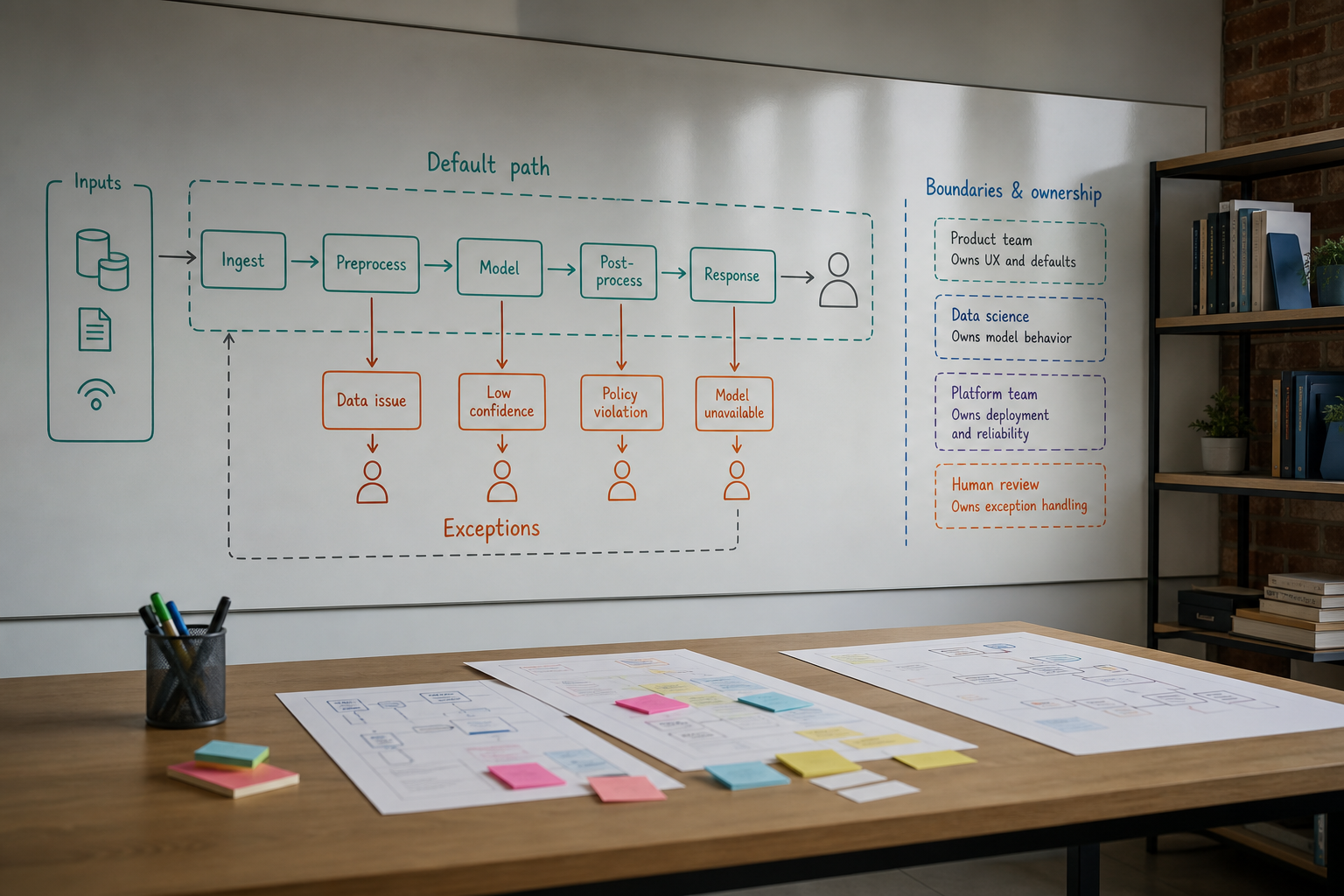
A promising AI demo can still create a bad product if the architecture does not answer a few basic questions: where the model runs, what data it can see, and what happens when it is wrong or unavailable.
That is the part teams often skip. Product architecture is not just a wiring diagram. It is the scheme that assigns function to components, and it shapes change, variety, performance, and how much work the product creates after launch.
The useful distinction is between stable parts of the design and variable parts. Stable steps usually belong in the core of the system, where consistency matters. Variable behavior is better isolated into modules, so the product can support different use cases without turning every change into a rebuild. That is how architecture affects the cost-variety tradeoff in plain terms.
For AI features, this shows up in a simple decision: should the model draft the answer, or should it only narrow the options for a person to review? If the UX does not make that boundary obvious, support teams inherit ambiguity, users lose trust, and operations have to explain behavior the product never made clear.
A good rule is to design around the failure mode first. If the model is unavailable, wrong, or uncertain, the product should still behave predictably. That usually means modularizing the AI layer, keeping review points visible, and making the fallback path part of the architecture instead of an afterthought.
That is how an AI feature becomes something teams can support, govern, and evolve without rebuilding the rest of the product.