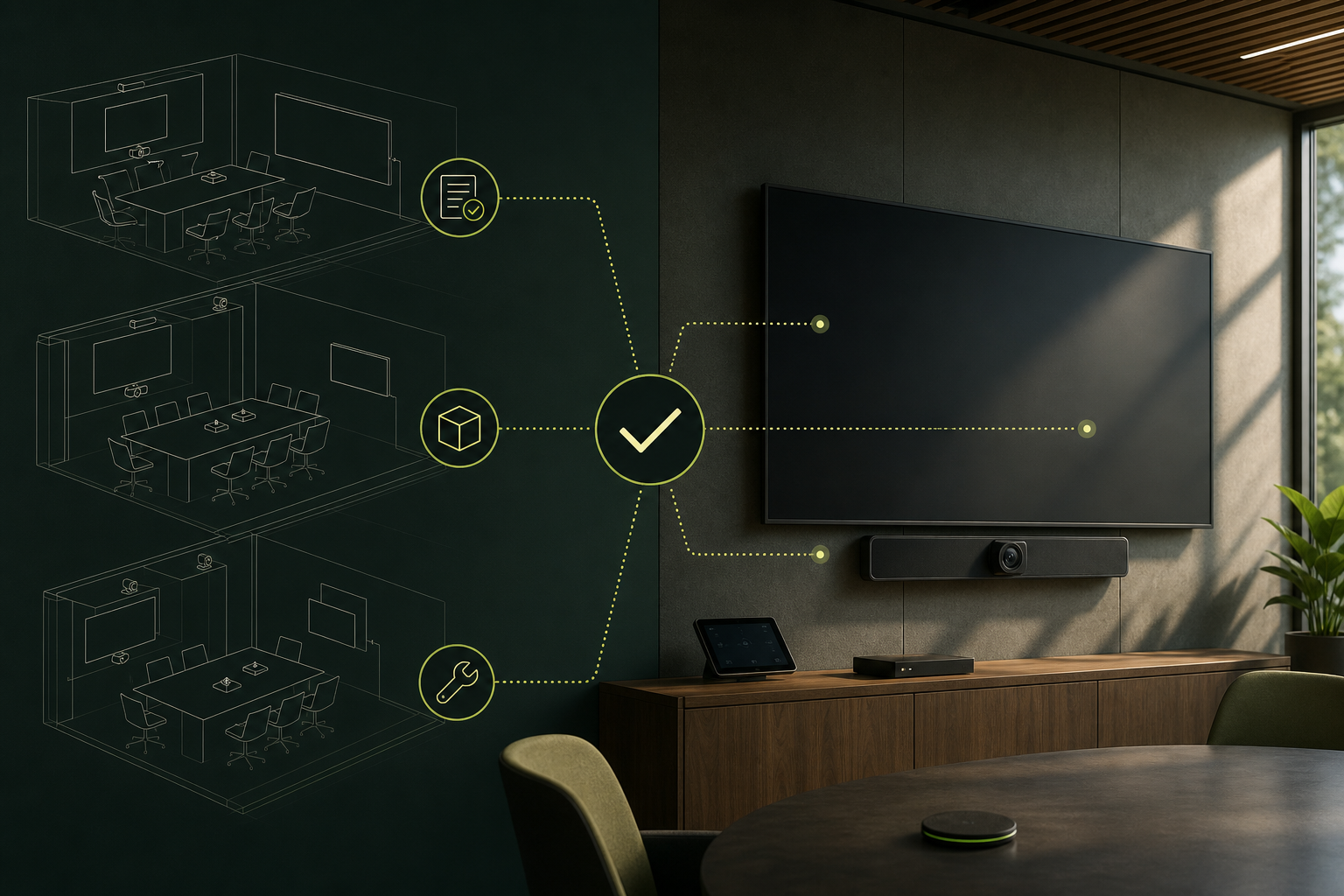
The pattern across enterprise AV is becoming clearer: the failure mode is rarely the codec, camera, or panel. It is the gap between a standard on paper and a standard that is enforced in the room.
That matters because enterprise AV is moving in two directions at once. On one side, unified stacks are consolidating ownership: one OEM or team may cover the camera, microphone, control, software, and support chain. On the other, AV systems are behaving more like managed IT assets: cloud-managed, API-driven, and expected to fit into enterprise governance.
My read is that the real decision rule is this: if a room cannot be built, labeled, commissioned, and supported the same way every time, the “platform” will not save you.
A practical lens:
- Standardize the physical build: rack layout, mounting methods, cable dressing, and labeling are not cosmetic details; they determine serviceability and outage recovery. - Treat closeout as part of the system, not paperwork. Photo documentation and device configuration records reduce ambiguity when support changes hands. - Prefer fewer ownership boundaries where possible. Unified stacks can reduce handoffs, but only if configuration and support responsibilities are explicit. - Use open APIs and cloud management where they improve monitoring, automation, and lifecycle control. Connectivity without governance just creates more ways to drift. - Match room type to meeting behavior. Most enterprise spaces still need standards-based meeting rooms first; other formats should be justified by the users, not by the technology trend.
The useful question is not “what equipment is best?” It is “what execution model makes this supportable for three to five years?” That is where reliability is won or lost.